
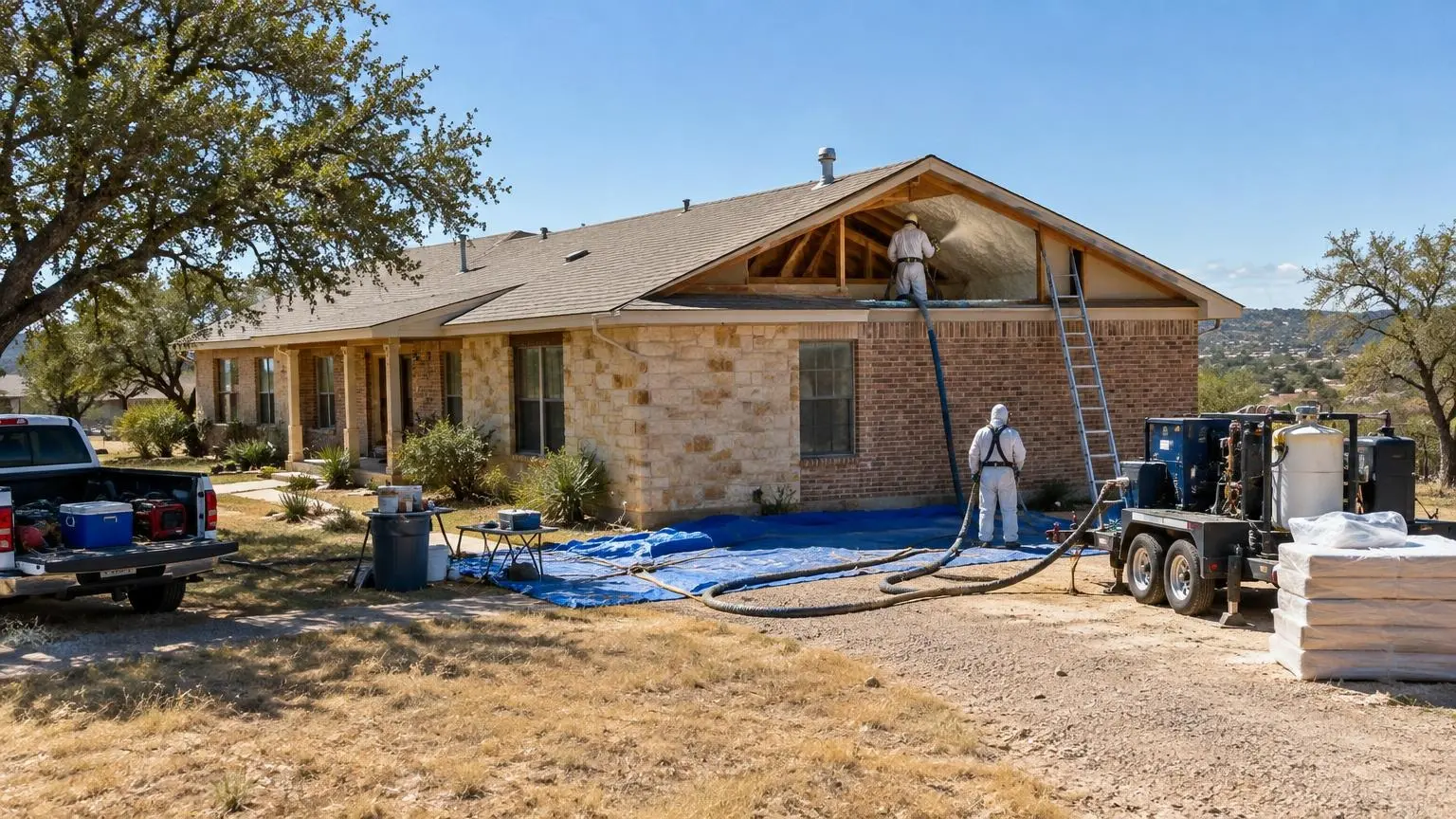
Homes, shops and barns across the Concho Valley
Spray Foam Insulation in San Angelo, TX
Keep West Texas heat out of the house and the shop, with foam where it earns its cost and blown-in where it does not.
- Free estimates after an on-site look
- Written quotes that name foam type, thickness and R-value
- Attic leaks, ducts and old insulation checked before we cover anything
Built for 100-Degree Summers
Spray foam insulation in San Angelo is mostly a fight against summer heat. Wikipedia's San Angelo climate summary says the city reaches 100F on about 30 days in an average year, and in 2011 it logged 100 such days. July afternoons average a high of 96.0F under the 1991-2020 normals. With an attic sitting above all that sun, and ductwork usually running through it, the attic decides how hard your air conditioner works. We seal and insulate attics, walls, shops, barns and metal buildings using open-cell or closed-cell spray foam where it is the best tool, and blown-in insulation where it gets the same result for less.
Winter still counts
San Angelo is not only hot. The same climate data show about 60 nights a year that drop below freezing, a January average low of 31.5F, and a record low of -4F. Snow and sleet show up a few times most winters. A leaky house loses heat on those nights the same way it loses cool air in July, so the air sealing we do pays twice. Closing gaps at the top plates, around plumbing and wiring, and at the attic hatch helps in every season.
What the code asks for here
OpenEI's county list classifies Tom Green County as ASHRAE Climate Zone 3B, the warm and dry band. Texas has not moved its statewide home energy code past the 2015 edition: a 2025 Senate bill analysis notes that the State Energy Conservation Office still uses the energy chapter of the 2015 International Residential Code. In Zone 3, that code's prescriptive table (summarized by PNNL's Building America Solution Center) asks for R-38 in ceilings, R-20 or R-13 plus R-5 continuous in wood-frame walls, and R-19 in floors. ENERGY STAR's guidance for existing homes in Zone 3 goes higher in the attic: R-49 if the attic is bare, and R-38 more if three to four inches are already there.
Where San Angelo houses lose the most
The city grew from Fort Concho, founded in 1867, into a regional center of about 100,000 people, and the 2020 census counted 43,316 housing units. That means everything from early-1900s frame houses near downtown to ranch homes from the oil and air base years to new subdivisions. Each type has its weak spots. Older homes often have little attic insulation and open framing between walls and attic. Mid-century ranches tend to have ducts in the attic with leaky joints and thin wrap. Newer homes can still have gaps at the attic hatch, recessed lights and the garage ceiling below a bedroom.
The pattern we see most is an attic floor with matted, uneven insulation, a few open chases, and ducts losing cool air into a space that is far hotter than the outdoors. Sealing those paths and bringing the insulation to depth is usually the first and best dollar spent.
Closed cell vs open cell
Open-cell foam is soft and expands a lot. It seals air well and fills rafter bays thickly for the money, and HomeGuide lists it at R-3.5 to R-3.7 per inch. It is the usual choice when we move the insulation to the underside of the roof deck so the attic and ducts sit inside the cooled space. Closed-cell foam is dense and rigid at R-5 to R-7 per inch, and it slows vapor and does not take on water. It is the better fit for metal buildings, tight spaces where only an inch or two fits, and spots near the ground. Every line on our quote names which foam we plan and why.
Spray foam vs blown-in in the attic
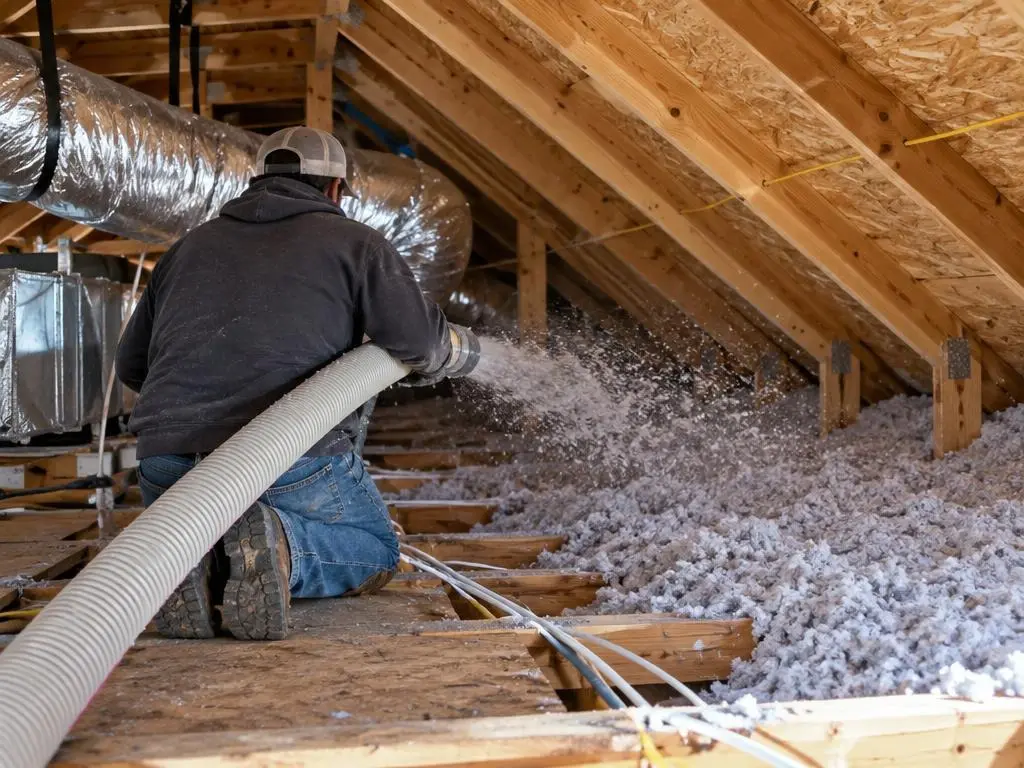
Foam is not automatically the answer. If your attic floor is open and easy to reach, sealing the ceiling penetrations and then blowing fiberglass or cellulose to R-38 or R-49 costs far less per R-value than foam. If the ducts and air handler live in the attic, or the roof shape leaves no room for deep loose fill, foaming the roof deck often makes more sense. We price both when both would work and tell you which we would choose for your house.
Spray foam insulation cost
HomeGuide's 2026 guide puts installed spray foam at $1.50 to $5.00 per square foot, with open-cell at $1.50 to $3.50 and closed-cell at $3.00 to $5.00. It lists a spray foam attic at $3,000 to $8,000 and a whole house at $8,000 to $20,000, and says many installers set a minimum of $1,000 to $2,000 or more. Blown-in insulation runs $1.00 to $2.80 per square foot in HomeGuide's blown-in guide. Use these national ranges to plan; access, foam type, thickness and any removal set the real number, and your written estimate is what you pay.
Questions to ask any insulation contractor
When you call spray foam insulation contractors or insulation companies around San Angelo, a short list of questions separates careful bids from quick ones. What will be sealed before anything is insulated? Which foam goes where, how thick, and what R-value does that give? If the roof deck is being foamed, how are the attic vents handled? Does exposed foam need an ignition or thermal barrier in that space? How long should the household stay out while it cures (HomeGuide says at least 24 hours)? What happens to the old insulation? If a bid is a single number with no thickness, ask for the details. Ours lists them by default.
Shops, barns and metal buildings
Ranch and farm country surrounds the city. Wikipedia notes that San Angelo's Producer's Livestock Auction is the country's largest for sheep and lambs, and plenty of properties around town include a steel shop, hay barn or equipment building. Bare steel turns into an oven in summer and drips condensation on cold mornings. Closed-cell foam sprayed on the panels and purlins insulates and stops that drip in one coat. Open-cell can work inside a building with a separate liner. We look at how you use the building before recommending either.
What We Do
Six kinds of work, matched to each part of the building, from foam on a shop roof to vacuuming out a tired attic.
Spray Foam Insulation
Open-cell and closed-cell foam that insulates and seals air in one layer, for roof decks, walls, shops and tight spaces.
Learn more →Attic Insulation & Air Sealing
Sealing the gaps between the house and the attic, then bringing attic insulation up to a Zone 3 level.
Learn more →Metal Building & Barn Insulation
Closed-cell foam for steel shops, barns, carports turned workshops and equipment buildings around the Concho Valley.
Learn more →Wall Insulation
Spray foam in open walls during remodels and additions, and injected or blown insulation for closed walls in older homes.
Learn more →Blown-In Insulation
Loose-fill fiberglass or cellulose blown into attics and walls to reach the depth the house needs.
Learn more →Insulation Removal & Replacement
Vacuuming out old, dirty or damaged attic insulation, cleaning up, sealing and installing new insulation.
Learn more →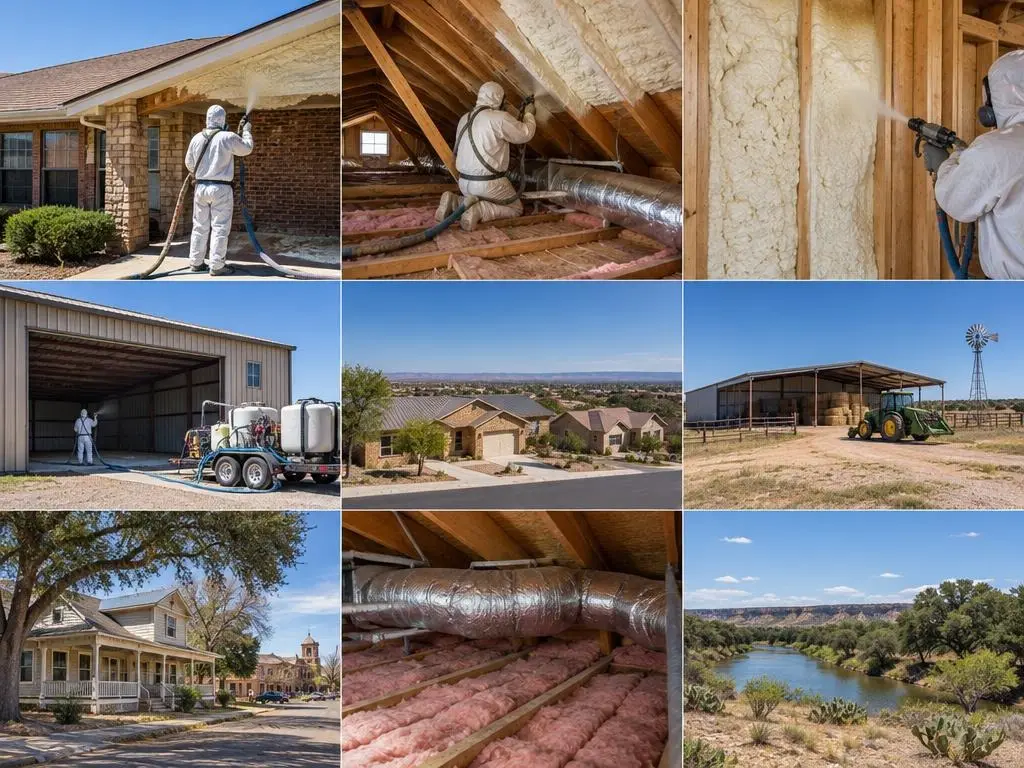
Why Homeowners Call Spray Foam Insulation San Angelo
We measure before we price
Every quote follows a look at the attic, walls or building, with depth and condition noted.
Air sealing comes first
Gaps at top plates, chases, lights, ducts and hatches are closed before insulation goes over them.
Foam only where it pays
If blown-in gets you to the same R-value for less in part of the house, we tell you.
A quote you can compare
Each area lists the material, thickness or depth, target R-value and price.
Common Questions
Is spray foam insulation worth it in San Angelo?
It often is where heat and air leaks meet: the underside of a roof deck with ducts in the attic, metal buildings, and tight spaces. On an open attic floor, sealed and topped with blown-in, you can usually reach the same R-value for less. We price the options side by side.
What R-value should a San Angelo attic have?
Tom Green County is in Climate Zone 3. The 2015 code table asks for R-38 in new ceilings, and ENERGY STAR suggests R-49 for an existing attic with no insulation, or adding R-38 where three to four inches are already there.
Why is spray foam sometimes called a red flag?
Mostly because of bad installs: foam sprayed too thick in one pass, put over roof leaks, or used without a plan for attic ventilation or moisture. Some buyers and inspectors also want to see the roof deck. Careful prep, the right foam and a written spec avoid most of those problems.
Who makes spray foam insulation?
Several chemical companies make the two-part foam systems that installers use, in both open-cell and closed-cell versions. What matters more for your house is that the product fits the space, is applied at the right thickness, and is covered where code calls for a thermal or ignition barrier.
How much does spray foam insulation cost in San Angelo?
National figures from HomeGuide put it at $1.50 to $5.00 per square foot installed, or $3,000 to $8,000 for a typical attic. Foam type, thickness, access and removal of old material change the total. Your written estimate is the price.
Can you insulate a metal shop or barn?
Yes. Closed-cell foam on the steel is the usual choice because it insulates and stops condensation at once. We look at the building, how you heat or cool it, and what is stored inside before we quote.
Towns We Cover Around San Angelo
We work across San Angelo and Tom Green County, including Grape Creek, Wall, Christoval and Water Valley, and out to nearby towns in neighboring counties: Miles and Ballinger in Runnels County, Robert Lee and Bronte in Coke County, Mertzon in Irion County, Paint Rock in Concho County and Sterling City to the northwest. Town pages cover what is different in each place: older stock in the county seats, farm and ranch buildings around the smaller towns, and newer homes on the edges of the city.
- Spray Foam Insulation in San Angelo, TX
- Spray Foam Insulation in Grape Creek, TX
- Spray Foam Insulation in Wall, TX
- Spray Foam Insulation in Christoval, TX
- Spray Foam Insulation in Water Valley, TX
- Spray Foam Insulation in Miles, TX
- Spray Foam Insulation in Ballinger, TX
- Spray Foam Insulation in Robert Lee, TX
- Spray Foam Insulation in Bronte, TX
- Spray Foam Insulation in Mertzon, TX
- Spray Foam Insulation in Paint Rock, TX
- Spray Foam Insulation in Sterling City, TX
Get a Written Insulation Estimate
We look at the attic, walls or building, then send a written price that lists the material and R-value for each area.